Reviews, Appearances & Quotes
The New York Times
Sunday, July 14, 1985
Jazz: Larry Vuckovich
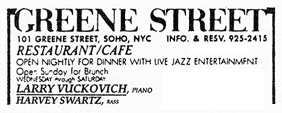
LARRY VUCKOVICH, a jazz pianist whose career has developed for the past 25 years on the West Coast, moved to the East Coast five months ago, bringing with him an outlook and a collection of influences that set him apart from most pianists who are heard regularly in New York.
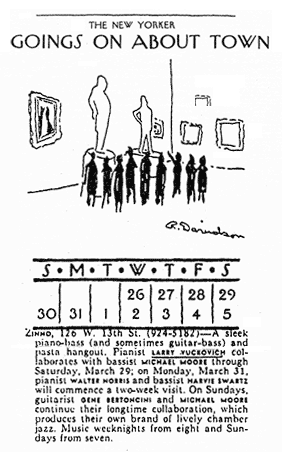
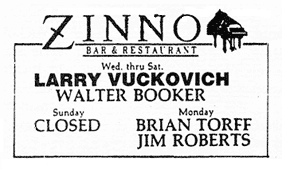
At Zinno, 128 West 13th Street, where he appeared through last night accompanied by the bassist Walter Booker, Mr. Vuckovich mixed a mainstream swinging attack, romanticism that bordered on the expansive Erroll Garner manner, a strong blues sensitivity and exotic reflections of his native Yugoslavia. The jazz influences that he cites as affecting his playing include some of the expected, familiar names – Bud Powell and Miles Davis as well as Red Garland, Tommy Flanagan and Barry Harris. But he also mentions John Handy and Monk Montgomery, echoes of his long residence in SanFrancisco, and the saxophonist Brew Moore.
This gives him a broad range of sources on which he draws in imaginative fashion, taking elements with which he can build peformances that are given unity by his own musical background. Playing a Yugoslavian folk theme, he evokes visions of minarets as readily as he develops a broad, deep exploration of the blues from Avery Parrish's "After Hours." His playing is warmly emotional, melodic and very positively swinging, an element that is underlined and extended by Mr. Booker's strong support.
- John S. Wilson
The New York Times
Monday, July 28, 1986
TV Reviews - JAZZY 'Club Date' on 31
JAZZ musicians with Eastern European roots can be seen tonight on Channel 31 in "Club Date," two half-hour jazz programs presented back to back at 9 o'clock. The Hungarian guitarist Gabor Szabo plays pop-jazz with a diluted flamenco element; the pianist Larry Vuckovich leads a superior quartet that adds hints of Mr. Vuckovich's Yugoslavian heritage to aggressive hard-bop.
But the second "Club Date," a 1982 set by Larry Vuckovich, is well worth tuning in for at 9:30 P.M. – especially because the pianist has made only a few albums. Mr. Vuckovich can summon the aggressive, modal style of 1960's jazz or a more ornate, more traditionalist approach. His quartet includes the trumpeter Tom Harrell, the drummer Sherman Ferguson and the first-rate bassist John Heard, who is based in Los Angeles and rarely performs in New York. In the final selection, a barrelhouse-flavored "After Hours," the alto saxophonist Charles McPherson joins the group for a wailing guest solo.
"Village Voices," which opens the program, mixes angular Slavic folk tunes with the modal style of McCoy Tyner. Mr. Vuckovich plays a romantic solo version of Billy Strayhorn's "Lush Life," and the punchy hard-bop of Mr. Harrell's tune "Blue News" completes the segment. For those who haven't heard the pianist in New York clubs, the program is a fine sampling.
- Jon Pareles
The Underdogs Of Jazz Piano
Gary Giddins, March 1983 Esquire
View/Download Article (PDF) →
The New York Times
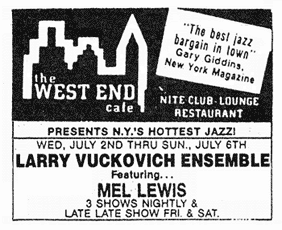
Larry Vuckovich Trio: West End Cafe, 2911 Broadway, at 114 St.
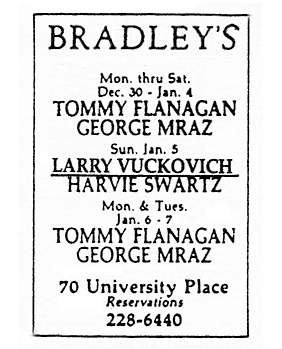
The Yugoslavian pianist Larry Vuckovich is a fleet-fingered beboper who can also play sultry, big-chorded blues. His repertoire includes both standards and more modern compositions, among them his own pieces, which reveal his Balkan heritage. Mr. Vuckovich's current trio features Mel Lewis on drums, in a different context from his well-known big band.
Personnel:Larry Vuckovich, pano; Joshua Breakstone, guitar; Dennis Irwin, bass; Mel Lewis, drums
- Jon Pareles
The Village Voice
Larry Vuckovich: West End Cafe
The Balkan bopper has a trio with Mel Lewis, and a book of piano gems that will keep you guessing.
- Gary Giddins
The New York Times
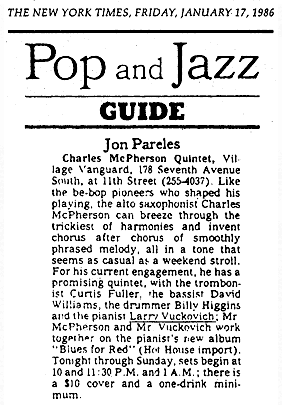
Charles McPherson Quintet, Village Vanguard, 178 Seventh Avenue South, at 11th Street.
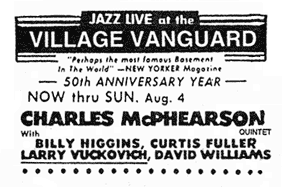
Like the be-bop pioneers who shaped his playing, the alto saxophonist Charles McPherson can breeze through the trickiest of harmonies and invent chorus after chorus of smoothly phrased melody, all in a tone that seems as casual as a weekend stroll. For his current engagement, he has a promising quintet, with the trombonist Curtis Fuller, the bassist David Williams, the drummer Billy Higgins, and the pianist Larry Vuckovich. Mr. McPherson and Mr. Vuckovich work together on the pianist's new album "Blues for Red" (Hot House Import).
Quotes.... What they're saying about Larry:
"When you are in your element bringing out your personal expression, you don't need to take a backseat to anybody." Jon Hendricks, saying this to Larry Vuckovich, commenting on his playing during their performance at the Town Tavern, Toronto, 1966 Jon Hendricks
"Larry Vuckovich worked with me tonight and he is something else" Don Byas, speaking to Quincy Jones at the Montmartre Club, Copenhagen, 1963
"I had some great accompanists, but this guy (Larry Vuckovich) is like radar. I want him for the next Monterey Jazz Festival." Mel Torme, speaking to Jimmy Lyons at the Safari Room engagement in San Jose, 1963
"Larry Vuckovich is an original voice on the piano. He plays with a lot of creative depth and feeling." Charlie Haden
"Larry really inspires musicians to give of themselves when they play with him. He has that effect on me." Tom Harrell
"Larry Vuckovich is a contemporary piano player because he uses devices that musicians use today, but he still has a firm understanding and respect for traditional jazz. When you put all those things together, you get a great musician." Charles McPherson
NYC Clubs